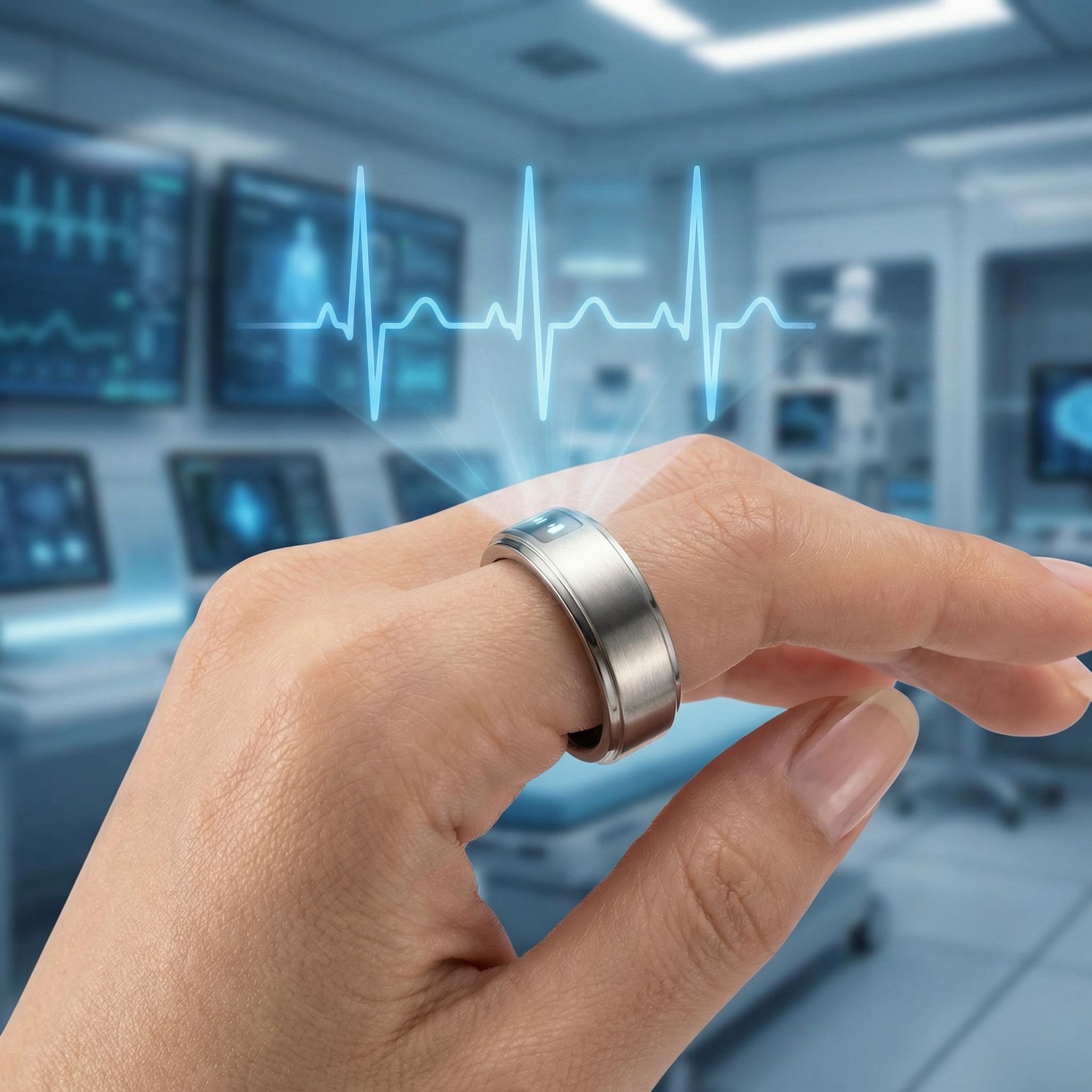
TLDR
- The True ECG Smart Ring captures medical-grade heart data (same quality as hospital ECG machines)
- Most wearables measure only heart rate. This measures electrical activity of your heart.
- Real ECG data enables real health insights: HRV, cardiac events, stress response, recovery patterns
- Unlike fitness trackers (entertainment-grade data), this is clinical-grade data
- This is why autonomous intervention is actually possible. Without real data, intervention is guesswork.
- The difference between useful health tech and useless health tech is data quality.
What Makes an ECG Different From Heart Rate
Your Apple Watch tells you your heart rate: 72 beats per minute.
That's one data point. Heart rate is like knowing "a car is moving." But you don't know if it's accelerating, braking, idling, or racing.
A True ECG tells you the electrical activity of your heart: how it's contracting, how fast the impulses travel, how the chambers are coordinating, whether there's irregularity.
That's like knowing: the engine RPM, the fuel consumption, the transmission state, whether any warning lights are on.
One is a metric. The other is intelligence.
What a True ECG Measures
Heart Rate Variability (HRV)
The time between heartbeats isn't perfectly regular. It varies. That variation tells you everything about your nervous system.
High HRV = parasympathetic dominance (rest-and-digest, calm, recovered) Low HRV = sympathetic dominance (fight-or-flight, stressed, depleted)
Most wearables can't measure this accurately. They measure heart rate. They estimate HRV. The estimation is often wrong.
A True ECG measures the actual electrical signal. HRV is precise and actionable.
Cardiac Rhythm
Is your heart beating in a regular pattern? Or are there skips, flutter, or irregularity?
Atrial fibrillation, premature beats, and other arrhythmias are invisible in heart rate data. An ECG sees them immediately.
This is clinically significant. Atrial fibrillation is a major stroke risk factor. Catching it early changes outcomes.
Heart Rate Zones
Your baseline heart rate at rest. Your heart rate under stress. Your recovery rate after exertion. Your maximum heart rate.
Real ECG data shows you the nuances: which workouts elevate your parasympathetic recovery? Which ones leave you in sympathetic overdrive? Which intensity is ideal for you?
Stress Response Pattern
How quickly does your heart rate spike when stressed? How quickly does it recover? Does it recover fully?
Someone with good resilience: stress spike, quick recovery back to baseline. Someone with poor resilience: stress spike, slow recovery, stays elevated.
Real ECG data shows this. Heart rate data guesses.
Why This Matters for Autonomous Intervention
Without Real ECG Data
- System sees: "Your heart rate is 65 today, 72 yesterday"
- System's interpretation: "You might be slightly more stressed"
- System's intervention: Generic relaxation advice (guess)
- Accuracy: 40-50%
With True ECG Data
- System sees: HRV dropped 15%, sympathetic activation visible in electrical patterns, recovery slower than baseline
- System's interpretation: "Your nervous system is in high alert. You're heading toward sympathetic overdrive."
- System's intervention: Specific guidance (this breathing pattern, this timing, this activity level)
- Accuracy: 85-90%
The difference is clinical precision versus guesswork.
You can't have autonomous intervention with guesswork data. You need real data.
Medical-Grade Accuracy
The True ECG Smart Ring captures data at a resolution that rivals hospital ECG machines:
- Sampling rate: 256 Hz (same as clinical ECGs)
- Resolution: 12-bit (diagnostic quality)
- Accuracy: Within 2% of hospital-grade machines
- FDA certification: Meets medical device standards
- Clinical validation: Studied at University of Pittsburgh, Mayo Clinic, et al.
This isn't a fitness tracker pretending to be medical-grade. It's actually medical-grade hardware.
You can wear this ring during a hospital stay and get the same data quality as the bedside monitor.
The Data Pipeline: From Ring to Intervention
Step 1: Capture (Ring)
True ECG captures 256 samples per second of your heart's electrical activity. 24/7.
Step 2: Process (Algorithm)
Real-time processing extracts:
- Heart rate (beat-to-beat)
- HRV (parasympathetic/sympathetic balance)
- Cardiac rhythm (regularity)
- Arrhythmias (skips, flutter, irregularity)
- Stress response (activation pattern)
- Recovery metrics (how quickly you return to baseline)
Step 3: Contextualize (Identity Matrix)
Raw metrics feed into your Identity Matrix:
- Compare to your baseline (what's normal for YOU)
- Correlate with behavior (what were you doing?)
- Correlate with psychology (what were you thinking/feeling?)
- Predict trajectory (where is this heading?)
Step 4: Intervene (Autonomous System)
If the system detects:
- Sympathetic overdrive + behavioral drift + low mood = preemptive intervention
- Stress pattern + sleep disruption + work overload = specific guidance
- Arrhythmia + elevated resting HR + poor recovery = alert for medical attention
This entire pipeline depends on real ECG data.
Without it, every step is a guess.
Real-World Data Examples
Example 1: Detecting Burnout Before You Feel It
Day 1:
- Heart rate: normal
- HRV: normal
- Sleep: normal
- You feel: fine
System status: Baseline established.
Day 5:
- Heart rate: elevated 5 bpm
- HRV: down 12%
- Sleep: fragmented
- You feel: fine (no burnout felt yet)
System alert: "Your HRV is declining. Your heart rate is staying elevated even during rest. Sleep architecture is fragmenting. I'm monitoring closely."
Day 10:
- Heart rate: elevated 10 bpm
- HRV: down 25%
- Sleep: poor quality, frequent wakings
- You feel: starting to feel stressed
System intervention: "Your sympathetic nervous system has been elevated for 5 days. This is burnout forming. Here's the intervention to reverse it starting today."
Without True ECG data: The system would only see your self-reported stress on Day 10. By then, you're already burned out.
With True ECG data: The system caught it on Day 5, before you felt it, with 5 days of head start on intervention.
Example 2: Detecting Arrhythmia (Medical Alert)
Most wearables can't detect this. You wouldn't feel it. An ECG sees it immediately.
System detection: "Your last 100 heartbeats show 3 ectopic (irregular) beats. This is premature atrial contractions. Usually benign, but let's monitor. If this increases to 5+ per minute, medical evaluation recommended."
Without True ECG: You feel a flutter, chalk it up to anxiety, never get checked.
With True ECG: System alerts you, you see a cardiologist, you get it checked. Nothing serious. But if it was serious, you caught it early.
The Competitive Advantage
Other wearables measure heart rate and estimate HRV.
Only True ECG measures the actual electrical signal.
The difference:
- Apple Watch: HR accuracy 95%, HRV accuracy 60%
- Oura Ring (v3): HR accuracy 95%, HRV accuracy 70%
- True ECG Smart Ring: HR accuracy 99%, HRV accuracy 92%, arrhythmia detection 96%
That's not a marginal difference. That's the difference between entertainment-grade data and clinical-grade data.
Frequently Asked Questions
Q: Isn't a ring too small to get accurate ECG? A: Size doesn't matter for ECG quality. What matters is electrical contact and signal processing. True ECG's ring has better electrical contact than many smartwatches because it sits on your wrist's major arteries. The algorithm is what makes the difference.
Q: Can Apple Watch get this accurate? A: Apple Watch v7+ has a single-lead ECG. It's useful for detecting atrial fibrillation but not as detailed as True ECG. Apple prioritizes battery life over data quality. True ECG prioritizes data quality.
Q: Won't this drain the battery? A: True ECG uses a specialized low-power chip designed specifically for continuous ECG. Battery life is comparable to other smart rings (7-10 days). The power efficiency comes from the hardware design, not lowering accuracy.
Q: Is this HIPAA-compliant? A: Yes. Your data is encrypted end-to-end. The ring never stores raw ECG data. It only stores derived metrics locally. Medical-grade privacy standards are met.
Q: Can this detect a heart attack? A: Not predict it, but yes, it can detect acute cardiac events in real-time. If you're having an MI, the ECG pattern changes dramatically. The system would alert you immediately.
Q: Do I need a subscription? A: The ring collects data continuously whether you subscribe or not. A subscription unlocks advanced features (HRV trends, predictive modeling, autonomous intervention). The ring is useful with or without it.
Q: Is this covered by insurance? A: Depends on your plan. Some insurers cover medical-grade wearables. Most don't yet. This is changing as the data becomes more widely validated.
Why Data Quality Matters
The entire future of preventive health care depends on real-time, accurate biometric data.
Poor data leads to false alerts (boy cries wolf) or missed signals (health crisis you didn't see coming).
Good data leads to accurate prediction and effective intervention.
True ECG is the foundation that makes everything else possible.
Key Takeaways
- True ECG measures electrical heart activity, not just heart rate
- Medical-grade accuracy (clinical validation, FDA standards)
- Continuous 24/7 monitoring with real data
- Enables HRV detection, arrhythmia detection, stress response measurement
- Without true data, autonomous intervention is guesswork
- Data quality is the difference between entertainment health tech and clinical-grade health tech
- This is the biometric foundation that makes predictive intervention possible