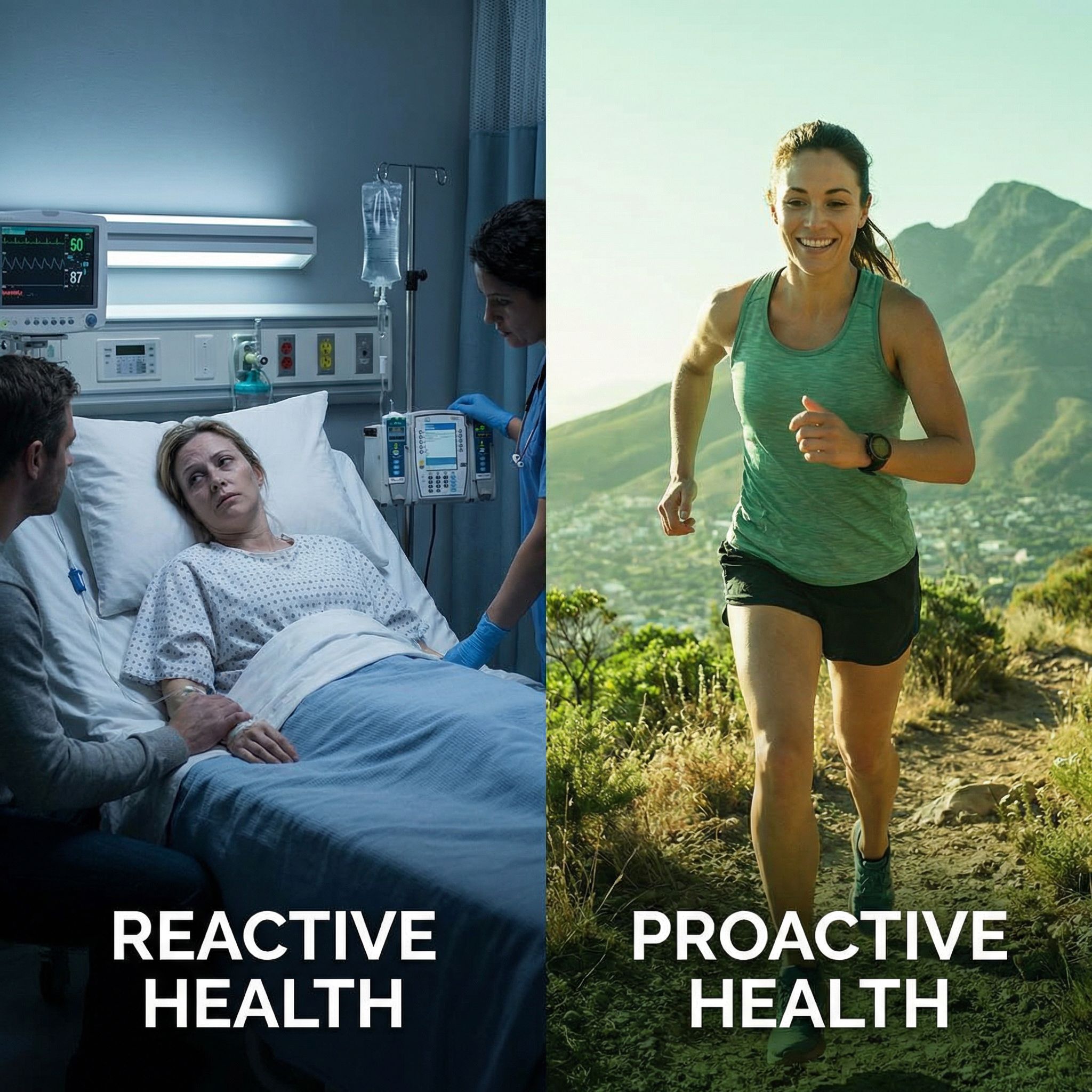
TLDR
- Reactive: You get sick, injured, or burned out, then seek help (Apple, Oura, traditional medicine)
- Proactive: System detects problems forming and intervenes before you feel them
- Reactive costs are massive (ER visits, hospital stays, lost work, resignations)
- Proactive costs are minimal (early intervention, prevention, baseline protection)
- The shift from reactive to proactive is the biggest opportunity in healthcare today
- This shift is only possible with real-time behavioral + biometric data and autonomous AI
The Reactive Trap
You know this model. It defines modern healthcare.
The reactive loop:
- You feel fine (no symptoms)
- Problem develops silently (stress accumulates, health declines)
- You feel symptoms (exhaustion, chest pain, emotional breakdown)
- You seek help (doctor, ER, therapist)
- You get treated (medication, intervention, recovery time)
- You return to baseline (hopefully)
The cost:
- ER visit: $2,500 average
- Hospital readmission: $14,400 average
- Day of work missed: $350 per employee
- Burnout resignation: $50,000+ replacement cost
The problem: By the time you feel symptoms, you're already in crisis. The intervention happens after the damage is done.
The Proactive Shift
A proactive system works differently.
The proactive loop:
- You feel fine (no symptoms yet)
- System detects early changes (behavioral drift, biometric shifts)
- System intervenes preemptively (guidance, support, schedule adjustment)
- Problem is prevented (you never enter crisis)
- You stay at baseline (continuous protection)
The cost:
- Smart ring + software: $600/year
- Early intervention: Minimal (small nudge, not crisis management)
- Work days protected: Preventable absenteeism eliminated
- Resignations prevented: Employee retention protected
The outcome: You never reach crisis. The intervention happens before you feel the problem forming.
Real Numbers: The Cost Comparison
Scenario: Employee Burnout
Reactive approach:
- Week 8: Employee shows burnout symptoms (low energy, cynicism, detachment)
- Week 9: Employee goes on stress leave (missing work, disrupting team)
- Week 10: HR is involved, looking for replacement
- Week 12: Employee resigns (company loses institutional knowledge)
- Cost: $350/day absence (8 weeks) + $50K replacement = $72,000
Proactive approach:
- Week 2: System detects behavioral drift (sleep declining, activity dropping, mood shifting)
- Week 2-3: System intervenes (schedule adjustment, support activation, workload discussion)
- Week 4: Employee stabilizes (baseline protected, crisis prevented)
- Cost: $600/year platform + minimal intervention = $600
Difference: $71,400 saved per prevented burnout.
For a company with 5,000 employees, preventing just 10 burnout resignations saves $714,000.
Reactive vs. Proactive in Healthcare
Hospital Readmissions
Reactive:
- Patient discharged from hospital
- Patient goes home with discharge instructions
- Patient doesn't follow instructions (confusion, overwhelm, fatigue)
- Patient decompensates 2-3 weeks later
- Patient returns to ER, gets readmitted
- Cost: $14,400 per readmission
Proactive:
- Patient discharged with monitoring ring + AI system
- System monitors biometrics + behavior in real-time
- At first sign of decompensation (24-48 hours), system intervenes
- Patient adjusts medication, increases monitoring, calls nurse hotline
- Patient stays at home, doesn't readmit
- Cost: $600 ring + software, prevented $14,400 readmission
Why Reactive Dominates Today
Reactive care is what we've built the entire healthcare system around.
- Hospitals make money from treating sick people
- Pharmaceuticals make money from treating disease
- Insurance companies pay for crisis management
Nobody makes money from prevention.
So even though proactive is cheaper and better, reactive is what we have.
This is changing. It has to. The costs are unsustainable.
The Conditions for Proactive Wellness
Three things are required:
1. Real-Time Data
You need continuous monitoring of biometrics, behavior, and psychology. Not weekly check-ins. Not monthly reports. Real-time, 24/7.
Without this, you're flying blind.
2. Autonomous AI
You need an AI that can interpret the data, recognize patterns, and act immediately without waiting for human approval.
A system that says "I notice X, here's Y intervention, starting now" is proactive.
A system that says "Here's your data, talk to your doctor next week" is still reactive.
3. Personalization
Generic interventions don't work. "Just exercise more" and "try meditation" fail because they ignore what you specifically need.
Proactive interventions must be personalized to your patterns, triggers, and preferences.
The Technology Requirement
Proactive wellness is impossible without:
- Medical-grade biometric data (True ECG, not estimated metrics)
- Behavioral tracking (activity, sleep, social patterns)
- Psychological input (mood, stress, motivation)
- Real-time processing (detecting changes in hours, not days)
- Autonomous decision-making (no waiting for approval)
This is why every current wellness app fails. They have maybe one pillar of data. They wait for you to interpret it. They offer generic advice.
That's still reactive, just slower.
The Shift Is Happening
The future of healthcare is proactive.
- Hospitals are beginning to measure readmission prevention (not just readmission treatment)
- Companies are measuring burnout prevention (not just burnout recovery)
- Patients are demanding prevention (not just crisis management)
The companies that build proactive systems win. The companies stuck in reactive lose.
Frequently Asked Questions
Q: Isn't prevention just avoiding disease? A: Prevention is catching problems before they become diseases. The window is weeks, not days. Reactive medicine sees the disease. Proactive medicine sees the warning signs.
Q: Why haven't more companies gone proactive? A: Because the reactive system is entrenched. Hospitals profit from treating illness. Insurance companies profit from crisis management. Proactive systems cannibalize their revenue. This is changing, but slowly.
Q: Can proactive care prevent everything? A: No. Some things are unpredictable (accidents, genetic conditions, infections). But burnout, chronic disease escalation, and preventable hospital readmissions are all detectable weeks early. That's huge.
Q: Does proactive care cost more? A: No. It costs less. A $600/year monitoring system prevents a $14,400 readmission. A $600/year employee wellness program prevents a $50,000 resignation. The math is overwhelming.
Q: Is this science fiction? A: No. University of Pittsburgh proved it: proactive monitoring reduces readmissions by 76%. This is clinically validated, not theoretical.
The Shift You Need to Make
If you're still relying on reactive wellness (wait for crisis, then fix it), you're paying 10-100x more than you need to.
Proactive wellness (detect early, prevent crisis) is available now.
The question isn't whether proactive works. The question is why you're still paying for reactive.
Key Takeaways
- Reactive: Crisis happens, you fix it ($14K+ per incident)
- Proactive: Crisis prevented before it happens ($600/year investment)
- Reactive dominates because the system is built around treating illness
- Proactive is the future because it's cheaper and better
- Three requirements: real-time data, autonomous AI, personalization
- University of Pittsburgh: proactive reduces readmissions by 76%
- The shift from reactive to proactive is underway