TLDR
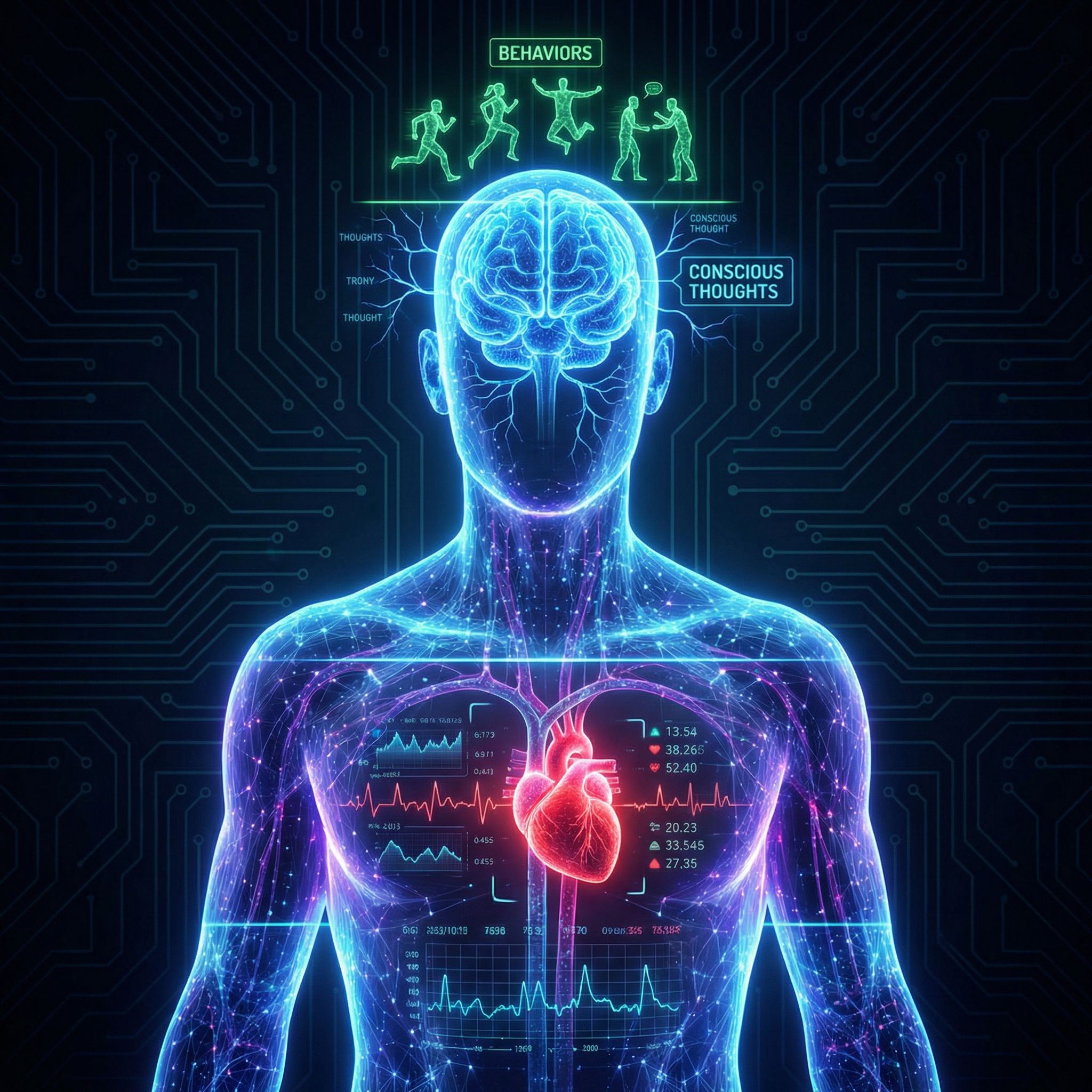
- The Identity Matrix is a continuously evolving digital mirror of who you are — mind, body, behavior, and emotion combined
- Built from three data pillars: biometric (True ECG), conscious (what you say), and behavioral (what you do)
- Traditional apps know about you. The Identity Matrix knows you.
- This isn't surveillance. It's the foundational architecture that makes autonomous intervention possible
- Without the Identity Matrix, personalization is impossible. With it, everything becomes personalized.
- The more time you spend with the system, the more accurate and useful it becomes
What Is the Identity Matrix?
An Identity Matrix isn't a static profile. It's a living, continuously updating model of:
- Your circadian rhythms
- Your stress patterns
- Your emotional states
- Your behavioral triggers
- Your capacity and resilience
- Your preferences and personality
- Your goals and values
- Your challenges and opportunities
It's not a questionnaire ("Tell us about yourself"). It's learned continuously from what you actually do, say, and experience in real time.
The system gets to know you better than you know yourself.
The Three Pillars of the Identity Matrix
Pillar 1: Biometric Data (The Physical You)
This is what your body is telling us.
What the True ECG Smart Ring captures:
- Heart Rate Variability (HRV): Your nervous system's state (are you in rest-and-digest or fight-or-flight?)
- Heart Rate Patterns: Resting, active, recovery, stress response
- Sleep Architecture: REM, deep sleep, light sleep, awakenings
- Stress Response: How your body reacts to stimuli
- Recovery Metrics: How well you bounce back from exertion
- Circadian Rhythm: Your natural wake/sleep timing
- Strain & Exertion: Physical load and adaptation
What this tells us:
- Your baseline health (energy, resilience, capacity)
- Your stress response pattern (how quickly you activate, how long to recover)
- Your sleep quality (not just hours, but structure and restoration)
- Your autonomic balance (parasympathetic dominance = calm; sympathetic dominance = stressed)
Why it's critical: Biometric data is objective. You can't lie about your HRV. You can't pretend you slept well if your sleep architecture says otherwise. The body always tells the truth.
Pillar 2: Conscious Data (The Aware You)
This is what you're explicitly telling the system.
What the system learns from you:
- Mood: How you're feeling right now (1-10 scale, or described in words)
- Stress: What's stressing you (work, relationships, health, finances, etc.)
- Energy: Your subjective energy level
- Clarity: Your cognitive capacity
- Motivation: What's driving you or holding you back
- Values & Goals: What matters to you, what you're working toward
- Fears & Worries: What's keeping you up at night
- Triggers: What situations tend to derail you
What this tells us:
- Your conscious experience (what you're aware of about your state)
- Your priorities (what you choose to focus on)
- Your beliefs (how you interpret your experiences)
- Your patterns (recurring themes in what you report)
Why it's critical: Biometric data shows your body's response. Conscious data shows your mind's interpretation. Together, they tell the complete story. You might have low HRV (stressed body) but high reported mood (determined mind). Or vice versa. The gap between the two is where real insight lives.
Pillar 3: Behavioral Data (The Doing You)
This is what you're actually doing in the world.
What the system learns from your behavior:
- Activity Patterns: Exercise, movement, sedentary time
- Sleep Behavior: When you sleep, how consistent it is
- Eating Patterns: Timing, regularity, stress eating indicators
- Social Patterns: Who you interact with, how frequently, communication style
- Work Patterns: Your typing, meetings, breaks, after-hours work
- Digital Patterns: App usage, social media, content consumption
- Substance Use: Caffeine, alcohol, medication patterns
- Recovery Rituals: What actually helps you recover
What this tells us:
- Your lifestyle (how you actually spend your time)
- Your coping mechanisms (what you do when stressed)
- Your support system (who you turn to)
- Your resilience (how you bounce back)
- Your capacity (how much you can handle before breaking)
Why it's critical: Behavior is where the rubber meets the road. You intend to sleep well (conscious intention) and your HRV suggests you need sleep (biometric reality), but your behavior (staying up until midnight) tells the real story. Behavior reveals what you actually value, not what you say you value.
How the Identity Matrix Evolves
Week 1: Initial Baseline
The system captures your baseline across all three pillars. This is your normal. This is what health looks like for you.
Week 2-4: Pattern Recognition
As you use the system, behavioral patterns emerge:
- When your HRV is highest (most resilient)
- When your mood is lowest (most vulnerable)
- What activities restore you
- What stressors affect you most
- How quickly you recover
- What your capacity actually is
Month 2-3: Predictive Modeling
The system starts predicting:
- When you'll likely be stressed (Tuesday morning meetings always spike your cortisol)
- When you'll be most resilient (Friday afternoon after your workout)
- What intervention you'll respond best to (you need solitude, not group support)
- What's about to happen (HRV drop + stress report + sleep shift = you're heading toward burnout)
Month 4+: Personalized Intelligence
The system becomes personalized because it knows:
- Your personality (are you highly sensitive? Resilient? Social? Independent?)
- Your triggers (what situations affect you specifically)
- Your preferences (what kind of support actually helps you)
- Your capacity (how much stimulation, change, or pressure you can handle)
- Your growth edges (where you could grow if supported properly)
The more time you spend with the system, the smarter it becomes about you.
Why Traditional Apps Don't Have an Identity Matrix
Most wellness apps capture one pillar only:
- Fitness apps: Just biometric/behavioral data (steps, workouts, calories)
- Meditation apps: Just conscious data (your intention to meditate, your reported stress)
- Mental health apps: Just conscious data (therapy notes, mood logs)
- Sleep apps: Just biometric data (sleep hours and patterns)
Each app knows about you in one dimension. None know you.
The gap: Without all three pillars, the system can't understand what's actually happening.
Example:
- Your sleep tracker says: "You slept 7 hours, but deep sleep is low" (biometric)
- Your mood app says: "Mood: 8/10, feeling great" (conscious)
- But your behavioral data shows: "You've skipped 3 workouts this week, eating larger meals, increased social media time" (behavioral)
What's really happening? You're recovering from something (low deep sleep), trying to feel good about it (high reported mood), but your behavior shows you're actually withdrawing and self-soothing.
One app would miss this completely. The Identity Matrix would see it immediately and offer preemptive support.
The Privacy Question: Is This Surveillance?
This is the question everyone asks. Fair question. Here's the honest answer:
How It Could Be Surveillance
- Unencrypted data
- Shared with third parties
- Used for targeting or prediction against your interests
- Stored indefinitely
- You don't have control or deletion rights
How It's Not Surveillance (If Built Right)
- End-to-end encrypted (only you and your AI can read it)
- Never shared without explicit consent
- Used only for your wellbeing
- You can delete any time
- You control your data completely
- Transparent about what's being tracked
The key difference: Surveillance is extracting value from data without your benefit. Support is using data to help you.
If the Identity Matrix makes your life better (prevents burnout, improves sleep, reduces anxiety), it's not surveillance. It's a tool.
If it's used to sell you things or manipulate you, then yes, it's surveillance.
The intention matters.
The Difference: Traditional Personalization vs. Identity Matrix
Traditional Apps
"We know you like fitness. Here are fitness tips." [Generic advice based on category]
Identity Matrix
"Your HRV drops on Tuesday mornings specifically. Your reported stress correlates with Monday meetings. You recover best after swimming (not running). When you're under pressure, you skip meals. Here's how to structure your Tuesday to prevent the HRV crash." [Specific advice based on your actual patterns]
The second isn't just better. It's a different category entirely.
Real-World Identity Matrix Examples
Example 1: The Sensitive Introvert
Your Identity Matrix learns:
- You have high HRV normally (calm, resilient)
- But large social events cause a 20-point HRV drop
- Your recovery takes 2-3 days (longer than average)
- You report higher stress after "team building" activities
- Your mood improves after solitude
- Your best sleep comes after quiet, low-stimulation days
System response: "You're sensitive to stimulation. Here's how to engineer quieter days this week. Before the team event, here's your pre-event buffer. After the event, here's your recovery plan."
Compare to generic advice: "Introversion is fine. Practice exposure therapy."
Example 2: The Anxious Overachiever
Your Identity Matrix learns:
- You have high baseline cortisol (stress hormone)
- Your HRV drops before deadlines (anticipatory stress)
- You work after 10 PM regularly
- You report high motivation but low sleep quality
- You're doing more when stressed, not resting
- Your recovery happens through achievement, not rest
System response: "Your body is telling you to rest, but your brain is telling you to push harder. You're in a cycle of anticipatory stress. Here's how to break it."
Compare to generic advice: "Try meditation and rest."
Frequently Asked Questions
Q: Does the Identity Matrix replace a therapist? A: No. A therapist provides clinical insight, emotional support, and relationship. The Identity Matrix provides real-time monitoring and preemptive guidance. Together, they're powerful. Separately, they each have limits.
Q: How accurate is the Identity Matrix? A: Accuracy improves with time. Week 1, it's ~60% accurate (normal baseline learning). Month 3, it's ~85% accurate (patterns established). Year 1, it's ~90%+ accurate (deep patterns understood). But it's never 100% — humans are complex.
Q: What if I want privacy? A: You have it. The system is encrypted end-to-end. Your data never leaves your device unless you explicitly allow it. You own your data. You can delete it anytime.
Q: What if I change? A: The Identity Matrix continuously updates. If you change jobs, move, start therapy, or go through life transitions, your baseline shifts. The system relearns. You're not locked into old patterns.
Q: Can this replace medical testing? A: No. The True ECG Smart Ring gives you real-time data, but it's not a replacement for bloodwork, imaging, or clinical exams. It's complementary to traditional medicine, not a substitute.
Q: How does this differ from an Apple Watch? A: Apple Watch is a device. It collects biometric data. The Identity Matrix is a system that integrates biometric + conscious + behavioral data into a unified model and acts autonomously on it. You can wear an Apple Watch and feed data into the Identity Matrix. The difference is what the system does with the data.
The Foundation of Autonomous Intervention
Here's the key insight: You can't have autonomous intervention without an Identity Matrix.
Generic intervention (meditation, sleep hygiene, exercise) works for some people, some of the time.
Personalized intervention (this specific practice, at this specific time, for your specific situation) works for you, most of the time.
The Identity Matrix is what makes personalization possible.
Key Takeaways
- The Identity Matrix is a living, continuously updating digital mirror of who you are
- Built from three pillars: biometric (True ECG), conscious (what you say), behavioral (what you do)
- Traditional apps know about you in one dimension; the Identity Matrix knows you completely
- Accuracy improves over time (60% week 1 → 90%+ year 1)
- Privacy is maintained through encryption and user control
- The Identity Matrix is the foundation that makes autonomous intervention actually work
- You're not locked into patterns; the system continuously updates as you change