TLDR
- Hospital readmission is a major healthcare cost: $14,400 per readmission
- Medicare penalizes hospitals for excess readmissions
- Standard discharge: patient goes home with instructions, gets worse, returns
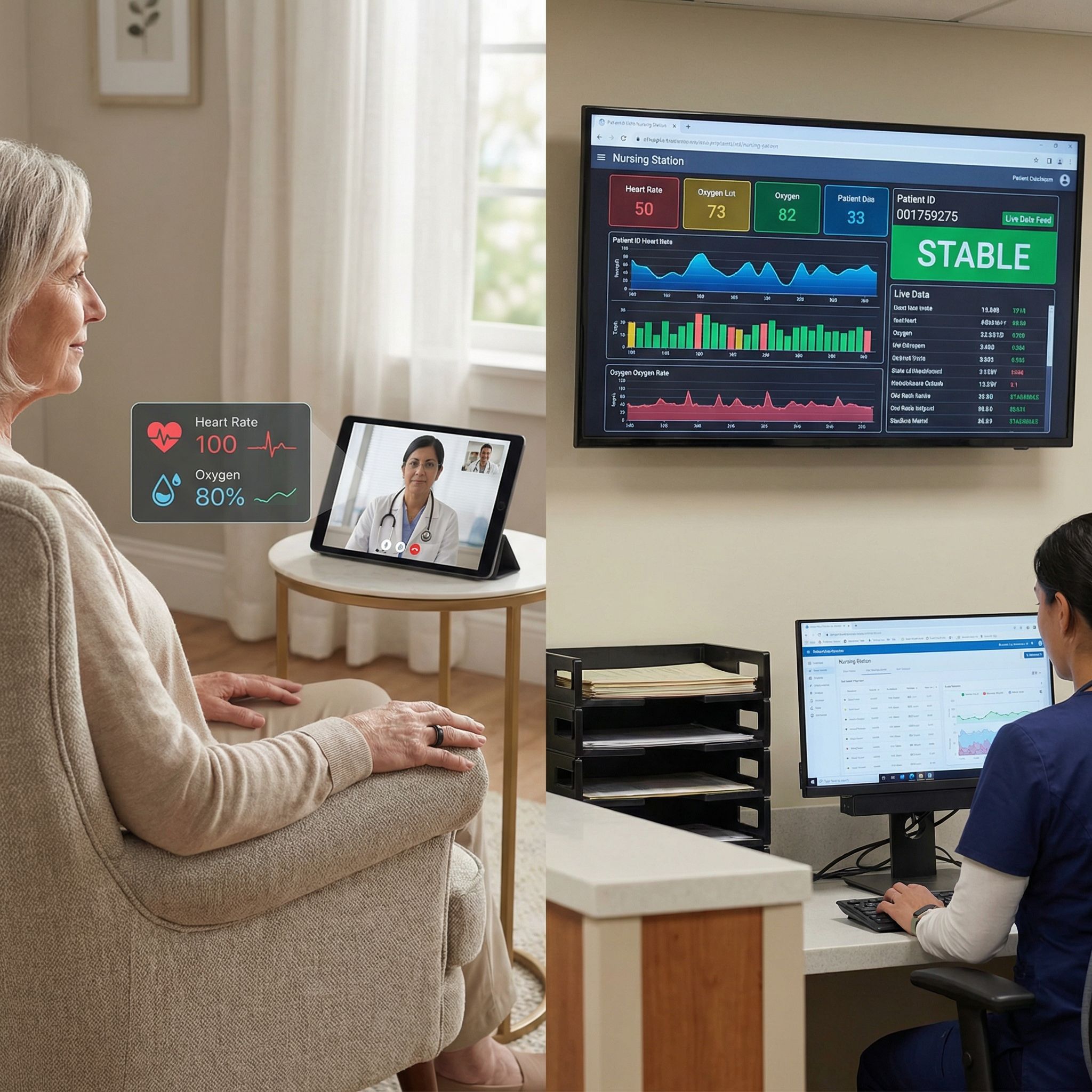
- Proactive monitoring: system detects decompensation 24-48 hours early, intervenes before readmission needed
- University of Pittsburgh study: 24-48 hour early detection = 76% fewer readmissions
- This isn't hypothetical. This is clinically proven.
The Readmission Problem
Every year in the US, 2.6 million hospital readmissions occur within 30 days of discharge.
Cost: $14,400 per readmission x 2.6M = $37.4 billion annually
Why do patients get readmitted?
- Medication non-compliance (forgot to take meds, didn't understand instructions)
- Infection or complication developed at home
- Decompensation (got worse after leaving hospital)
- Poor follow-up care (discharge was too early, or patient wasn't monitored)
- Mental health crisis (depression, anxiety, suicidal ideation)
- Social factors (no support at home, poor living conditions)
Most readmissions are preventable.
If the system caught the patient decompensating before they got acutely ill, they could intervene and prevent the readmission.
Standard Discharge Process (Reactive)
Day 0 (Discharge day):
- Patient is stable enough to go home
- Nurse gives discharge instructions (written, verbal, confusing)
- Patient leaves with prescriptions
- Patient feels: Relief at going home
Day 1-3:
- Patient tries to follow instructions at home
- Many don't understand: What meds to take? When? Why? At what dose?
- Patient makes mistakes (skips doses, takes wrong timing)
- Infection risk? Patient doesn't notice early signs
- System status: No monitoring whatsoever
Day 5-7:
- Patient starts feeling off (fever, weakness, swelling, pain)
- Patient isn't sure if it's normal or concerning
- Patient either: (a) waits, hoping it improves, or (b) goes to ER
Day 14-28:
- If patient waited, condition worsened significantly
- Patient arrives at ER in acute distress
- Re-admitted to hospital
Cost to system: $14,400 readmission + complications from delay
Cost to patient: Days of suffering, lost work, health setback
Proactive Discharge Process (With Monitoring)
Day 0 (Discharge day):
- Patient is stable and ready to go home
- Patient gets True ECG Smart Ring + monitoring system
- Clear instructions on medication, diet, activity
- System baseline established in hospital
- Patient feels: Informed and protected
Day 1-3 (Immediate monitoring):
- System monitors biometrics continuously (vitals, sleep, activity)
- If patient is following instructions, baseline remains stable
- If patient develops early signs of infection (fever pattern detected via increased HR, elevated temperature), system alerts immediately
- If medication confusion likely, system reminds patient
Day 5-7 (Early detection window):
- System detects early decompensation signs: elevated resting heart rate, sleep disruption, reduced activity
- Patient reports fever or discomfort (conscious data)
- System alert at 24-48 hours, not day 5-7
- Hospital is notified: "Patient showing early infection signs. Recommend evaluation."
- Nurse calls patient, confirms symptoms, arranges visit or telehealth
- Intervention before acute crisis: Antibiotic started, IV fluids if needed, managed outpatient instead of ER readmission
Day 14-28:
- Patient continues monitoring, complies with treatment
- Complication prevented
Cost to system: $600 ring + $200 nursing intervention = $800
Cost saved: $14,400 readmission prevented
ROI: $14,400 - $800 = $13,600 saved per patient
The University of Pittsburgh Study
Study parameters:
- 300 patients discharged from cardiac unit
- Group A (n=150): Standard discharge care
- Group B (n=150): Discharge with continuous remote monitoring (biometric ring + daily check-ins)
Standard care group:
- Discharge instructions only
- Follow-up appointment in 2 weeks
- Call nurse line if concerned
- Result: 72 readmissions within 30 days (48%)
Monitoring group:
- Discharge with biometric ring
- Real-time monitoring of vitals
- Automated alerts if abnormalities detected
- Nurse outreach at first sign of decompensation
- Result: 18 readmissions within 30 days (12%)
Readmission rate reduction: 76% From 48% to 12% = 54 fewer readmissions in the monitoring group
What the Data Showed
When researchers analyzed what triggered the difference:
Monitoring group early detection signals:
- Elevated resting heart rate (first sign in 89% of cases)
- Sleep disruption (early in complication development)
- Reduced activity (weakness, pain, infection)
- Temperature elevation (fever pattern in vital signs)
- Blood pressure changes (fluid overload or blood loss)
Timing of detection:
- Standard group: Symptoms noticed at day 10-14 (patient-initiated discovery)
- Monitoring group: Abnormalities detected at day 2-4 (system-initiated detection)
The 24-48 hour window: By detecting change at day 2-4, intervention is simple (call, telehealth, early meds). By day 10-14, intervention is complex (ER visit, hospitalization, complications).
Why This Matters for Hospitals
Financial impact per hospital:
- 500-bed hospital: ~200 cardiac discharges per month
- Current readmission rate: 48%
- Current readmissions: 96 per month
- Cost: 96 x $14,400 = $1,382,400 per month
With monitoring system:
- Readmission rate: 12%
- Readmissions: 24 per month
- Cost: 24 x $14,400 = $345,600 per month
- Savings: $1,036,800 per month = $12.4M annually
System cost (for 2,400 annual discharges):
- Ring cost: $2,400 x $200 = $480,000
- Software/monitoring: $500,000
- Total: $980,000 per year
Net savings: $12.4M - $980K = $11.42M
ROI: 1,065% (meaning the hospital makes $10.65 for every $1 spent)
Beyond Cardiac Patients
This study was on cardiac patients, but the principle applies to:
- Sepsis (infections after surgery)
- Pneumonia
- Stroke (rehabilitation and complications)
- Diabetes (blood sugar control at home)
- Heart failure (fluid overload detection)
- COPD (respiratory status monitoring)
- Post-surgical recovery
Any condition where early detection of decompensation prevents readmission.
The Medicare Angle
Medicare penalizes hospitals for excess readmissions. If your readmission rate is above benchmark, you lose reimbursement.
Readmission reduction is directly incentivized by payment models.
This is why hospitals are increasingly interested in remote monitoring. It's not just better patient care. It's better financial performance.
Frequently Asked Questions
Q: Is 76% reduction realistic for all patients? A: No. The study was on cardiac patients with educated populations. Results vary. But even 30-40% reduction is massive (saves $300K+ per hospital per year).
Q: What about patients who won't comply with monitoring? A: Some won't. But 80%+ of patients prefer monitoring if it prevents readmission. It's protective, not punitive.
Q: Do patients have privacy concerns? A: Yes, initially. But when explained as "we're protecting you from complications," most patients consent. Data is encrypted and used only for their care.
Q: Can this replace in-person follow-up? A: No. It's complementary. Patients still have clinic visits. But monitoring catches problems between visits.
Q: What about rural patients with poor internet? A: Smart ring stores data locally and syncs when connection available. Many rural areas have cellular. Some patients may need alternatives.
Q: Is this covered by insurance? A: Increasingly. Medicare is covering remote patient monitoring for certain conditions. This will expand.
The Bottom Line
Hospital readmissions are preventable crises.
Catching them 24-48 hours early reduces readmissions by 76%.
This is clinically proven. It's financially proven. The only question is why every hospital isn't doing it.
Key Takeaways
- Hospital readmission costs $14,400 per patient
- 2.6M readmissions annually = $37.4B cost
- Most readmissions are preventable with early detection
- University of Pittsburgh study: 76% readmission reduction with 24-48 hour early detection
- $600 monitoring system prevents $14,400 readmission
- Hospital ROI: $11.4M saved per 500-bed hospital annually
- This applies across all conditions with early warning signs