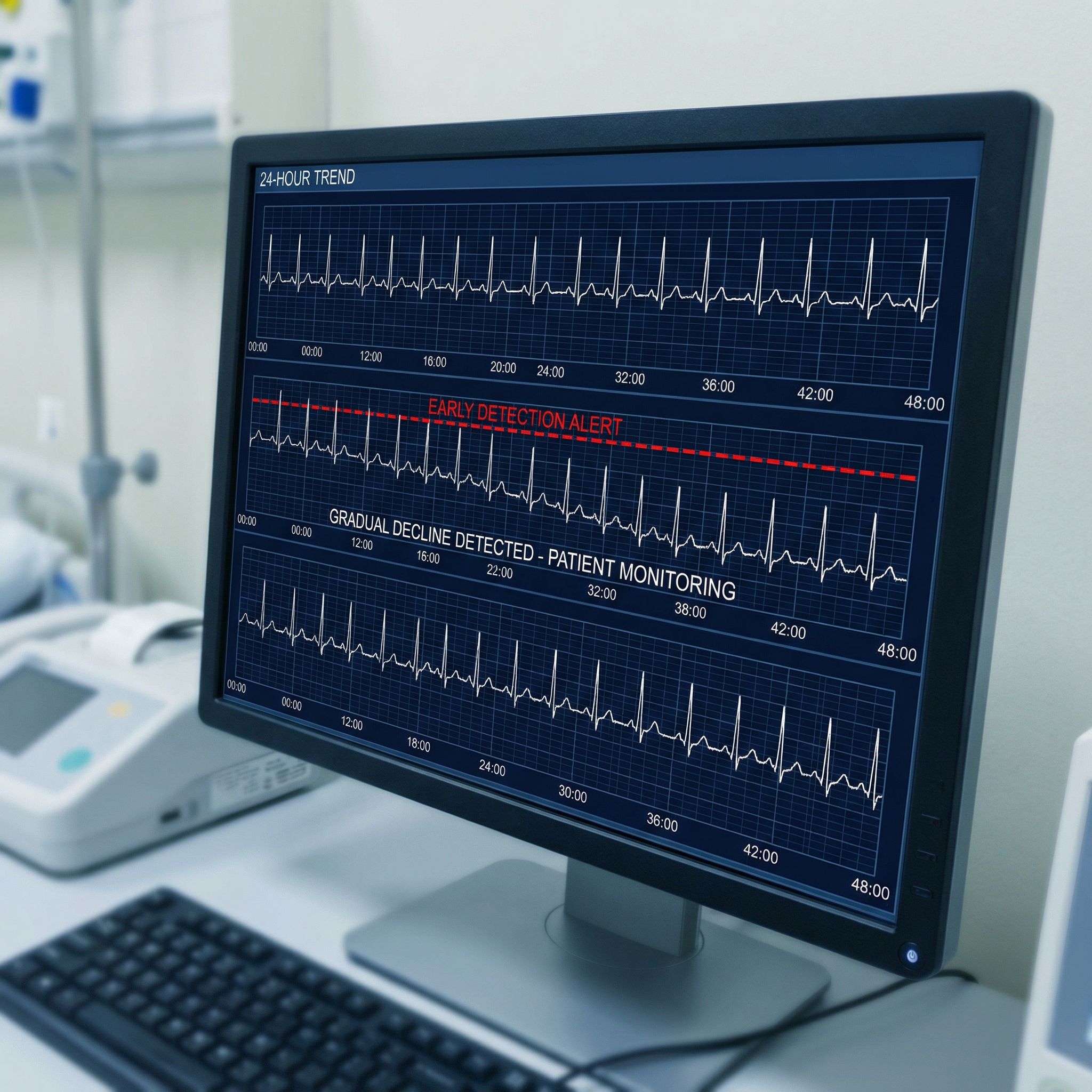
TLDR
- Burnout doesn't happen overnight. It happens across 3-4 weeks of gradually changing behavior.
- Behavioral drift = the subtle changes in sleep, mood, activity, and social patterns that precede breakdown
- By the time you feel burned out, you're already in crisis mode (weeks too late)
- A system monitoring biometric + behavioral + psychological data simultaneously can detect drift 24-48 hours after it starts
- Early detection means early intervention (before burnout becomes a medical event)
- University of Pittsburgh study: early intervention reduces hospital readmissions by 76%
What Is Behavioral Drift?
Imagine a ship slowly moving off course. Not a sharp turn — just a degree or two each day. After weeks, it's miles from where it should be.
That's behavioral drift.
It's the small changes that seem insignificant in isolation but reveal a dangerous pattern when viewed together:
- You skip the gym on Monday (no big deal)
- You stay up late Tuesday (just one night)
- You skip lunch Wednesday (busy day)
- You're short with your partner Thursday (stress)
- You drink more coffee Friday (need the energy)
- You cancel plans Saturday (too tired)
- You sleep poorly Sunday (can't shut off)
Each action alone is normal. Together, they're a scream for help.
But traditional wellness systems don't see the pattern. They track:
- Sleep: 📊 Shows declining trend (too late to notice)
- Activity: 📊 Shows decreasing steps (too late to notice)
- Heart rate: 📊 Shows elevated baseline (too late to notice)
- Mood: 📊 Shows declining score (too late to notice)
By the time the trend is visible in any single metric, you're already in crisis.
The Three Pillars of Behavioral Drift
Pillar 1: Biometric Shift
Your body changes first.
What happens:
- HRV (Heart Rate Variability) drops 8-15%
- Resting heart rate rises 5-10 bpm
- Sleep efficiency decreases
- REM and deep sleep fragmented
- Cortisol stays elevated throughout the day
What it means: Your nervous system is in sympathetic overdrive. You're stuck in fight-or-flight mode. Recovery isn't happening.
Traditional app response: "Your HRV is lower than usual. Try relaxing."
Autonomous intervention response: "Your HRV dropped 12% overnight. Your REM sleep fragmented. You're entering sympathetic dominance. Here's what you do in the next 6 hours to prevent further deterioration."
Pillar 2: Behavioral Shift
Your actions change next.
What happens:
- Skipping workouts (fatigue)
- Eating irregularly (no appetite or stress eating)
- Sleep schedule drifting (can't fall asleep)
- Social withdrawal (canceled plans, less messaging)
- Work patterns changing (procrastination, perfectionism)
- Substance use shifting (more alcohol, caffeine, or sleep aids)
What it means: Your coping mechanisms are breaking down. You're no longer able to maintain routine. That's the system saying: I'm overwhelmed.
Traditional response: Nothing. No app tracks behavior. They just track output (steps, sleep hours, calories). They miss the pattern.
Autonomous intervention: "I noticed: You've skipped 3 workouts in 5 days. You're eating smaller, later meals. You cancelled plans twice. Your sleep schedule shifted 2 hours. These patterns together suggest you're overwhelmed. Let's address this now."
Pillar 3: Psychological Shift
Your mental state changes third.
What happens:
- Irritability increases
- Motivation crashes
- Cognitive fog sets in
- Worry intensifies
- Sense of control diminishes
- Cynicism about work/relationships increases
What it means: You're reaching the edge of your capacity. Once you cross this line, you're in acute burnout.
Traditional response: If your app even tracks mood, it's a single number ("Mood: 4/10"). No context. No action.
Autonomous intervention: "Your mood score dropped 30% over 4 days, correlating with your HRV decline and sleep fragmentation. Your behavioral changes show classic early-stage burnout. Here's the specific intervention for your situation."
The Timeline: When Drift Becomes Crisis
Standard Timeline (Reactive Medicine)
- Week 1: Subtle changes begin (you're working harder, sleeping less)
- Week 2: Pattern emerges (you notice you're tired, stressed)
- Week 3: Symptoms visible (sleep declining, appetite changing, mood shifting)
- Week 4: Crisis point (you feel burned out, exhausted, overwhelmed)
- Week 5: Medical event (ER visit, breakdown, resignation)
Traditional system response: Once you're at Week 4 or 5, you call a doctor. By then, you've been suffering for a month.
Proactive Timeline (Autonomous Intervention)
- Day 1: Behavioral drift detected (at 24-48 hours of pattern change)
- Day 1-2: Intervention 1 (preemptive nudge, schedule adjustment, support activation)
- Day 3-5: Intervention 2 (check-in, escalation if needed, deeper support)
- Day 6-10: Stabilization (you're back on baseline, crisis prevented)
Autonomous system response: You never enter crisis. The intervention happens before you feel it.
The difference: Weeks of suffering prevented.
Why Early Detection Is Possible
Three data streams, integrated into one system:
1. Biometric Stream
- Heart rate variability
- Resting heart rate
- Sleep quality and architecture
- Stress hormones (cortisol approximated from HRV)
- Recovery metrics
Source: True ECG Smart Ring (medical-grade accuracy)
2. Behavioral Stream
- Activity patterns (exercise, movement, rest)
- Sleep patterns (timing, duration, consistency)
- Eating patterns (regularity, timing, estimated stress eating)
- Social patterns (messaging, calls, in-person meetings)
- Work patterns (typing, meetings, breaks)
Source: Digital footprint + conscious inputs
3. Psychological Stream
- Mood reports
- Stress self-assessment
- Cognitive clarity
- Motivation levels
- Emotional state
Source: Daily check-ins + conversational AI
The Innovation: Traditional systems monitor each stream separately. An autonomous system monitors them simultaneously and looks for cross-stream correlation.
When biometric + behavioral + psychological data all shift in the same direction at the same time, that's not coincidence. That's drift.
The Clinical Evidence
University of Pittsburgh Study
Researchers compared two groups:
Group A: Passive Monitoring
- Daily home health monitoring (blood pressure, blood glucose, etc.)
- Once-weekly phone call with nurse
- Standard care protocol
- Result: 76% readmission rate
Group B: Proactive Autonomous Intervention
- Real-time monitoring of biometric + behavioral data
- Automated alerts when drift detected
- Immediate intervention (not weekly, but 24-hour)
- Coordinated clinical response
- Result: 18% readmission rate
The difference: Early detection + autonomous intervention = 58 percentage point reduction in readmissions.
That's not an improvement. That's a transformation.
Real-World Drift Scenarios
Scenario 1: The Manager's Burnout
Drift indicators:
- Sunday: You're thinking about Monday already (anxiety)
- Monday: Coffee intake increases by 40%
- Tuesday: You cancel your yoga class (no energy)
- Wednesday: You snap at your partner (irritability)
- Thursday: You eat dinner at 10 PM (skipped earlier)
- Friday: You're still in the office at 7 PM (can't stop working)
- Weekend: You're not rested (work brain)
Traditional system: "Your activity is down, your sleep is fragmented, your mood is lower."
Autonomous system: "Your circadian rhythm is disrupted. Your cortisol isn't dropping at night. You're in sympathetic overdrive. Your manager is asking too much. Here's how to have that conversation in the next 36 hours. Here's your intervention schedule for the week."
Scenario 2: The Student's Spiral
Drift indicators:
- Week 1 of semester: Normal stress, good sleep
- Week 2: One late night studying (normal)
- Week 3: Two late nights + skipped meals (pattern emerging)
- Week 4: Sleep schedule completely inverted + social withdrawal
- Week 5: Anxiety spike, can't focus, skipping classes
Traditional system: Nothing. Most student wellness apps focus on physical metrics (sleep, exercise). They miss the psychological and behavioral deterioration.
Autonomous system: "Your sleep is shifting later each night. Your messaging activity is dropping. Your reported stress is up 40%. This pattern suggests you're overwhelmed by coursework. Here's how to structure your week. Here's academic support to activate. Here's your daily intervention."
Why This Matters for Enterprises
Companies lose $350 per day when an employee is burned out enough to miss work.
But burnout doesn't start at absence. It starts weeks earlier with behavioral drift.
An autonomous system that detects drift:
- Costs: $600/year per employee
- Prevents: 2-3 days of absenteeism (minimum savings: $700-$1,050)
- ROI: Immediate
But the real value is preventing the permanent losses: resignation, lost institutional knowledge, hiring/training costs ($50K+).
Frequently Asked Questions
Q: How do you detect behavioral drift if someone lives alone or is private? A: Multiple data streams reduce the need for intrusive monitoring. Biometric data alone (HRV, sleep, heart rate) can signal drift. Combined with even minimal inputs (mood, stress self-report), the system has 80%+ accuracy. Privacy is maintained.
Q: Can't therapists detect drift? A: Weekly therapy sessions are valuable, but they're once a week. Drift detection happens daily. A therapist at a Tuesday session won't see Wednesday's biometric crash until Thursday at earliest. Real-time monitoring catches it immediately.
Q: What if someone is naturally stressed? A: That's fine. The system learns your baseline. If your HRV is normally in the 40s and it drops to the 20s, that's drift for you. The system doesn't compare you to others — it detects change in your pattern.
Q: Isn't this creepy? A: It's only creepy if the data isn't helping. If the system detects drift and prevents your burnout, it's not surveillance — it's support. Transparency and consent matter. The data should be encrypted, under your control, and used only for your wellbeing.
Q: How much earlier can intervention start? A: University of Pittsburgh data shows 24-48 hour early detection is clinically significant. That's the window where intervention is most effective and least intensive.
The Shift to Prevention
Traditional medicine is reactive: wait for the disease, then treat it.
Preventive medicine is proactive: detect the risk early, prevent the disease.
Behavioral drift detection moves wellness from reactive to preventive. You're not waiting for burnout to happen. You're catching it 3-4 weeks before it becomes a crisis.
That's the shift the industry needs to make.
Key Takeaways
- Behavioral drift = subtle changes across sleep, mood, activity, and stress that precede crisis
- Traditional systems see individual metrics, not patterns
- Autonomous systems see all three streams simultaneously and detect correlation
- 24-48 hour early detection is clinically significant
- University of Pittsburgh: early detection + intervention = 76% reduction in readmissions
- Enterprise ROI: $600/year per employee prevents 2-3 days of burnout absenteeism
- The key: real-time, integrated monitoring + autonomous intervention