TLDR
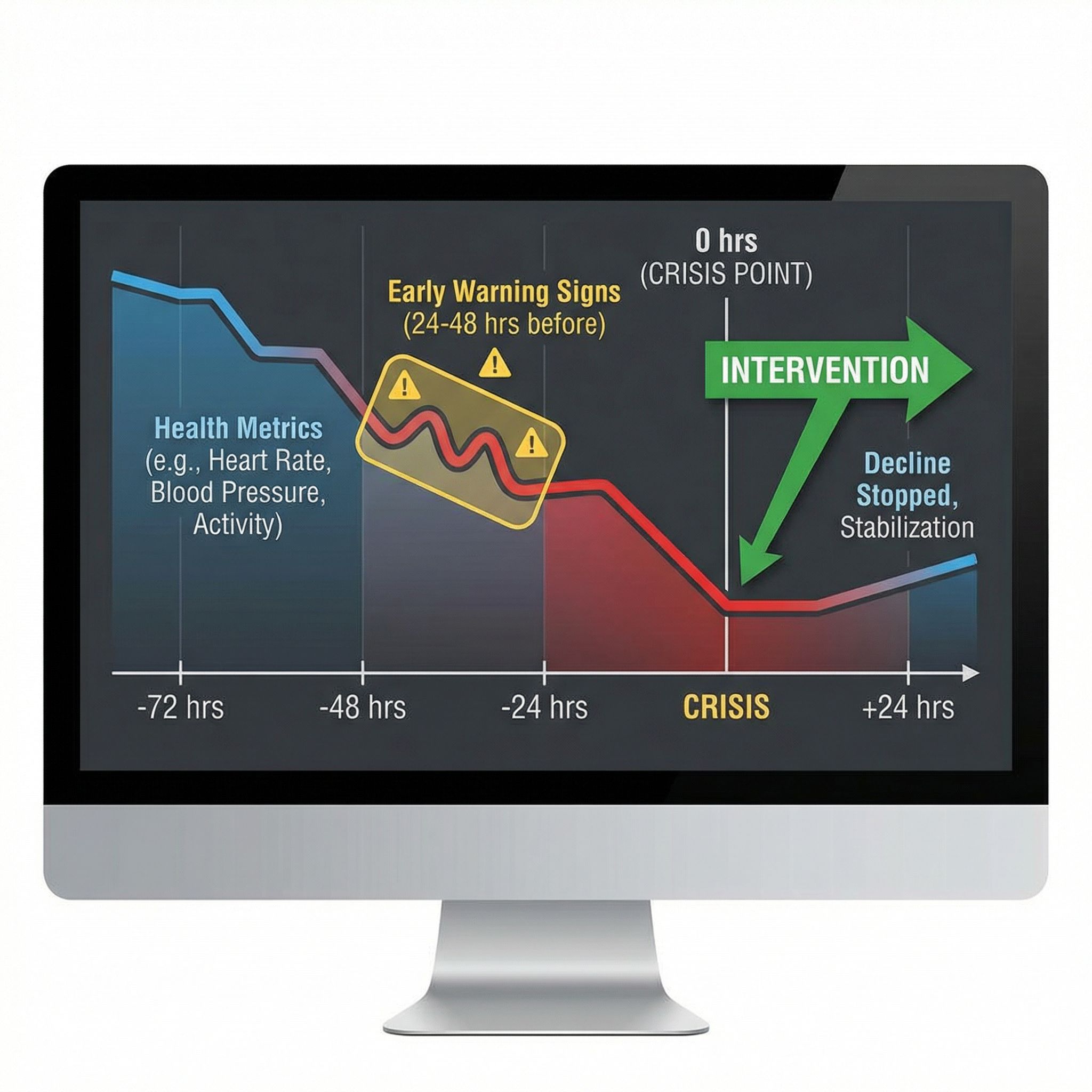
- Health crises don't happen overnight. They form over 3-4 weeks.
- But the decision point is 24-48 hours. This is when intervention works best.
- Miss this window and you're in acute crisis (burnout, ER visit, breakdown).
- Catch this window and the crisis never happens.
- University of Pittsburgh: 24-48 hour early detection + intervention = 76% reduction in readmissions
- This window only exists if you're monitoring continuously in real-time
The Timeline of Burnout
Let's trace a typical burnout trajectory.
Week 1: Subtle Changes Begin
- Work is intense (normal)
- You're sleeping slightly less (nothing unusual)
- Your HRV drops 3% (still normal range)
- You feel: Fine
Week 2: Pattern Emerges
- Work intensity continues
- Sleep is 30 minutes shorter most nights
- Your HRV drops another 5%
- You're having more coffee
- You feel: Slightly tired, but handling it
Week 3: The 24-48 Hour Window Opens
- Sleep has shifted to 6 hours (down from 7.5)
- HRV is now 18% below baseline
- Heart rate stays elevated even at rest
- You cancelled one social plan
- You feel: You notice you're tired, but attribute it to work
- THIS IS THE INTERVENTION WINDOW
Week 4: Crisis Forming
- Sleep is chaotic (can't fall asleep, wake frequently)
- HRV is 30% below baseline
- Resting heart rate elevated 12 bpm
- You're withdrawn from friends, irritable with family
- You feel: Exhausted, overwhelmed, cynical
- THE WINDOW IS CLOSING
Week 5: Acute Crisis
- Sleep architecture destroyed (no deep sleep)
- HRV is critically low
- You feel: Burned out, can't focus, considering quitting
- Medical event possible: anxiety attack, depression diagnosis, resignation
Why 24-48 Hours Matters
In that 24-48 hour window at week 3, three things are true:
- The signal is clear to a monitoring system but not to you yet
- Intervention is still simple (schedule adjustment, workload relief, sleep protocol)
- Prevention is still possible (reverse the trajectory before it compounds)
After 48 hours, the window starts closing:
- The signal gets stronger (more data, clearer pattern)
- But intervention gets harder (you're already fatigued, less resilient, more resistant)
- Prevention becomes crisis management (medical intervention, time off work, professional help)
Real Example: The Manager's Burnout
Day 1 (Monday Morning)
- HRV: 65 (baseline)
- Sleep: 7 hours, good quality
- Mood: 7/10
- Activity: Normal
- System note: Baseline established
Day 3 (Wednesday Morning)
- HRV: 58 (down 11%, still normal range)
- Sleep: 6 hours, fragmented
- Mood: 6/10 (slightly lower)
- Activity: Normal
- System note: Monitoring slight decline
Day 5 (Friday Evening) - THE 24-48 HOUR WINDOW
- HRV: 48 (down 26%, now abnormal)
- Sleep: 5.5 hours last 2 nights
- Mood: 4/10 (noticeably lower)
- Activity: Skipped gym twice
- System Alert: "Your HRV has dropped 26% in 4 days. Sleep is degrading. Mood declining. This pattern suggests early-stage burnout forming. Intervention window is open for next 24-48 hours. Here's what you need to do."
What the manager feels: "I'm tired. Work was intense."
What the system sees: "Sympathetic nervous system dominance is building. If this continues 4 more days, you'll be in acute burnout. Let's reverse it now."
The Intervention
If caught in the 24-48 hour window, intervention is straightforward:
- Immediate schedule shift (reduce meetings, extend deadlines, delegate tasks)
- Sleep protocol (8 hours minimum, consistent bedtime, wind-down ritual)
- Stress reduction (scheduled breaks, movement, solitude)
- Check-in (next 48 hours: monitor if trajectory reversed)
Probability of success: 85-90% if caught in the window
Time to recovery: 3-7 days back to baseline
Miss the Window
If the system doesn't detect it, or if you ignore the alert:
Days 9-14: Acute Burnout
- HRV drops to 30 (critically low)
- Sleep is completely disrupted
- Mood is 2-3/10 (depressed, cynical)
- You feel: Broken, unable to function
- Medical involvement: Therapy, medication, possible hospitalization
Time to recovery: 4-8 weeks minimum
Productivity loss: 40-60% reduction (work quality, decision-making, focus)
Relationship cost: Irritability, withdrawal, conflict
Risk: Resignation, long-term mental health issues
Why Traditional Systems Miss This Window
Most wellness apps operate on a weekly or monthly basis.
- You log your mood once a week
- Your data gets processed weekly
- You get a report, see your average is declining
- By then, it's been 5-7 days of decline
- You're already moving from week 3 to week 4 (past the intervention window)
By the time you realize something is wrong, you're already in crisis.
The only way to catch the 24-48 hour window is with continuous, real-time monitoring.
Clinical Evidence
University of Pittsburgh Study (Hospital Readmissions)
Researchers compared two discharge protocols:
Group A: Standard care
- Patient discharged with instructions
- Check-in at 1 week, 2 weeks, 1 month
- Readmission rate: 76%
Group B: Real-time monitoring
- Patient discharged with continuous biometric monitoring
- System alerts if decompensation begins (24-48 hours)
- Immediate intervention (call nurse, adjust meds, increase monitoring)
- Readmission rate: 18%
The difference: Catching the 24-48 hour window reduced readmissions by 58 percentage points.
The Technology Required
To catch the 24-48 hour window, you need:
- Continuous monitoring (not weekly, daily, hourly)
- Real-time data processing (not batch, not delayed)
- Pattern recognition (detecting 24-48 hour shifts, not week-long trends)
- Autonomous alerting (immediate notification, not waiting for you to check the app)
- Immediate intervention (in minutes/hours, not days)
This is why smartwatches fail. They collect data daily or weekly. By then, the window is past.
This is why True ECG + autonomous AI works. It monitors every heartbeat, detects changes in real-time, alerts immediately.
The Math: Cost of Missing the Window
If you catch the window:
- $600/year prevention platform
- 4 hours of intervention (professional support)
- 3-7 days recovery time (productive work resumes)
If you miss the window:
- $600/year platform (did nothing)
- 40 hours+ of medical intervention (therapy, medication, hospitalization)
- 4-8 weeks recovery time (weeks of lost productivity)
- $50,000+ cost (if it leads to resignation)
The difference is catastrophic.
And it all hinges on catching the 24-48 hour window.
Frequently Asked Questions
Q: How do you detect a 24-48 hour change? A: By monitoring minute-to-minute data, not weekly data. Your HRV at a granular level, your sleep architecture, your heart rate variability, your activity patterns. Real-time monitoring shows changes that weekly stats hide.
Q: What if I ignore the alert? A: That's your choice. The alert is informational. If you choose to ignore it, the system keeps monitoring. By day 3-4, the alert escalates because the window is closing.
Q: Can this work for other health conditions? A: Yes. Type 2 diabetes, heart disease, depression, anxiety, chronic pain. Any condition with a prodromal (warning) phase has a 24-48 hour intervention window. The earlier you catch it, the simpler the fix.
Q: Why don't doctors use this? A: Most doctors don't have access to real-time patient data. They see patients once a month. The window is long past. This is changing as remote monitoring becomes standard.
Q: Is this overkill? A: If you're healthy and stable, maybe. But if you're at risk (high stress, chronic illness, history of burnout), this is the difference between prevention and crisis. The cost difference is 10-100x.
The Shift
Healthcare is shifting from reactive to proactive.
That shift hinges on catching the 24-48 hour window.
If you can catch that window, you prevent crises. If you can't, you manage them.
The entire future of preventive health depends on this.
Key Takeaways
- Health crises form over weeks, but the intervention window is 24-48 hours
- Catch the window: simple intervention, 3-7 day recovery
- Miss the window: complex intervention, 4-8 week recovery
- University of Pittsburgh: 24-48 hour detection = 76% fewer readmissions
- Cost difference: $600 prevention vs. $50K+ crisis management
- Requires continuous real-time monitoring, not weekly check-ins
- This window only exists if you're watching for it